

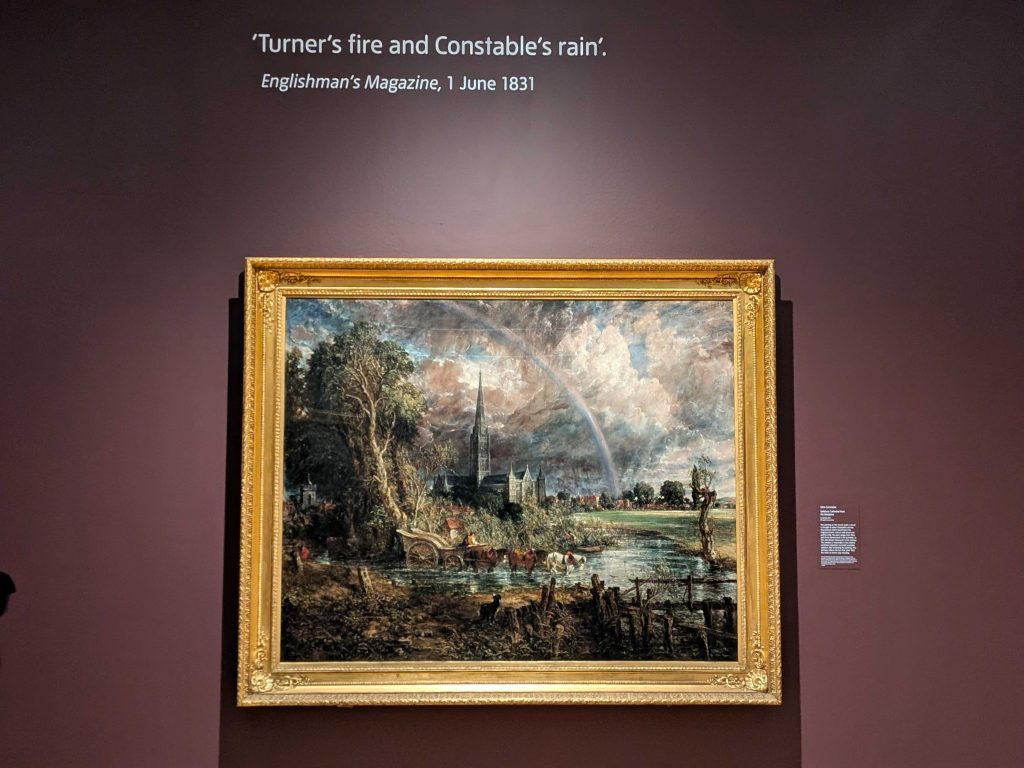
Some figures (or brands) become permanently linked in public imagination. Before my visit to Tate Britain’s Turner & Constable rivals & originals exhibition (ends 12 April 2026), I didn’t know these two great artists had been compared so often. Coming from an international background, I was definitely more familiar with Turner’s work. It was a discovery to read extracts from press articles from their lifetime with phrases such as “Turner’s fire and Constable’s rain” or “Mr. Constable’s works present no stronger contrast than they do with Mr. Turner’s…The first is all truth, the last all poetry: the one is silver, the other gold”.
From a PR point of view, being compared to someone with their own star power can elevate your visibility, but it may also frame your narrative in ways you don’t choose or control. A rivalry narrative can be powerful, but once it takes root it becomes the lens through which everything else is interpreted.
Rivalries are often constructed because they’re easy to understand: dualities simplify the world and our brains are naturally drawn to tidy contrasts. But for the individuals or brands caught inside them, the simplification can feel flattening. The Duchess of Sussex and the Princess of Wales can attest to this, being pitted against each other for all kinds of silliness from eating avocado for breakfast to the colour of their winter coats.
When your brand becomes intertwined with another figure’s you become part of a larger story. You may struggle to escape comparison, but you can also become era-defining. Think of Messi’s Barcelona and Ronaldo’s Madrid years, that marked the history of football forever (much as Pele and Maradona had done a couple of decades before).
Unfortunately, you can’t always stop the world from pairing you with someone but you can influence how the story evolves. Any narrative that isn’t actively managed tends to harden into something that’s difficult to redirect later. Acknowledging the connection instead of rejecting it is one option: Burger King and McDonald’s play with the comparison often, as does Pepsi with regards to Coca Cola. David Bowie and Freddie Mercury didn’t keep each other at arm’s length, instead they collaborated on one of the greatest songs in history with “Under Pressure” and allowed it to enrich both legacies.
Another option is using the visibility to launch your re-invention, and build new storylines that don’t rely on the old pairing. Steve Jobs reframed his company from “Microsoft’s competitor” to the mobile and hardware pioneer we now know. The more distinct your work becomes, the harder it is for cheap comparisons to dominate the story.
Providing journalists and the general public with alternative narratives creates a freshness to your story than can help you lean into your individuality. New projects, new collaborations and new direction create opportunities to reframe brands. Your work, your values, and your evolution should provide multiple entry points into the story you want to share.
Being tied to someone else in the public narrative is a double‑edged sword. It can give you scale, attention, and cultural permanence but it can also constrain your identity and overshadow your independent achievements. But, as rivalries fade, contexts shift, and cultural tastes change if you are able to clearly and consistently communicate who you are (on your own terms) you have a good chance of overcoming the comparison games.